
The True Cost of a DIY Partner Visa: Why Half of DIY Applications Fail
If you are an Australian citizen or permanent resident falling in love with someone from the Philippines, bringing them home to Australia is the natural next step. You want to build a life together, wake up in the same time zone and finally close the distance. But standing between you and that dream is the Australian Partner Visa process. It is a notoriously complex, expensive and stressful legal mountain to climb.
Question
Is it worth applying for an Australian Partner visa yourself, or could a DIY mistake cost you more?
Answer
Preparing your own Australian Partner visa application can save professional fees, but mistakes can put your application—and your plans to live together—at risk. According to Down Under Visa, common DIY problems include relying on a marriage certificate without sufficient supporting evidence, overlooking the financial and household aspects of the relationship, misunderstanding de facto requirements, and failing to respond adequately to requests from the Department of Home Affairs.
The real cost of a DIY application is not just the time spent completing forms. It is also the risk of refusal, the potential loss of non-refundable visa application charges, and the delay and emotional strain of having to reconsider your options.
Down Under Visa's approach is to assess the evidence across the four aspects of a relationship—financial, household, social and commitment—before lodging. Before you submit, identify the weaknesses in your evidence and address them while you still have the opportunity. Professional assistance can help identify potential problems, but no agent can guarantee approval.
In an effort to save a bit of money, many couples decide to take the Do It Yourself route. They gather some photos, download the forms, ask a few questions in Facebook groups or increasingly turn to Artificial Intelligence tools like ChatGPT for legal strategy. They reckon that because their love is genuine, the Department of Home Affairs will simply see the truth and stamp the visa.
Unfortunately, the Australian immigration system does not run on romance. It runs on cold, hard evidence and strict legislative criteria. When couples underestimate this, the results are often financially and emotionally devastating.
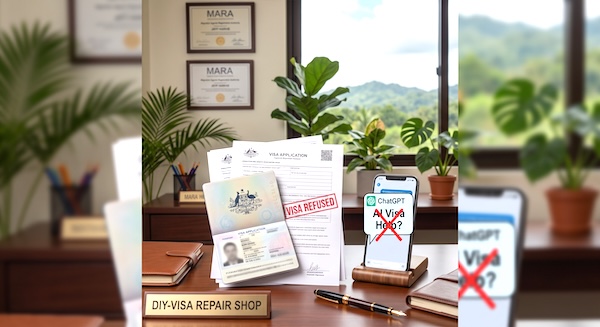
As the principal of Down Under Visa, operating right here in Manila, my wife Mila and I see the fallout of failed DIY applications every single week. Through our DIY Visa Repair Shop, we are constantly contacted by panicked couples who have received a Section 56 Request for Information, a Section 57 Natural Justice letter or an outright visa refusal.
To help you avoid becoming another statistic, let us look at the actual data behind DIY partner visa applications, why they fail at such alarming rates and why relying on chatbots or internet forums is the fastest way to jeopardise your future together.
The Startling Statistics: DIY versus Professionally Represented Applications
There is a widespread misconception that partner visas are straightforward and that paying a professional is just an unnecessary luxury. The data tells a very different story.
Historically, Freedom of Information requests to the Department of Home Affairs have revealed a startling picture regarding the success rates of unrepresented partner visa applications. For the 2015 to 2016 financial year, statistics showed that an incredible 53.8 percent of DIY partner visa applications were refused. The following year, it was slightly better but still alarming at 47 percent.
Let those numbers sink in. Roughly half of all couples who lodged a partner visa without the assistance of a migration professional had their visas refused.
By contrast, while the Department’s overall primary refusal rate for all partner visas generally hovers around 10 percent blended across all applicants, established migration agencies typically see success rates upwards of 98 percent. Why? Because a good agent will not lodge an application that is destined to fail. We identify the red flags, fix the evidentiary gaps and ensure the application meets every single legislative requirement before it ever reaches a Case Officer.
When you factor in that the current government lodgement fee for a partner visa is nearly $12,000 AUD, a DIY refusal is a catastrophic financial loss. Partner visa fees are strictly not refundable. If you fail, the government keeps your money, you remain separated from your partner and any future applications become significantly more difficult and heavily scrutinised.
Why Do DIY Partner Visas Fail?
Couples whose visas are refused are rarely trying to scam the system. Most are in deeply genuine, committed relationships. They fail because they simply do not understand what the Migration Act 1958 requires them to prove.
Here are the most common traps that unrepresented applicants fall into:
1. The Marriage Certificate Fallacy
The single biggest misconception among DIY applicants is the belief that a marriage certificate or a relationship registration certificate for de facto couples is the only piece of paper needed to prove a genuine relationship. This is completely false. In the eyes of Australian immigration, a marriage certificate simply proves that a ceremony took place. It does not prove that you share a life.
2. Failing the Four Pillars of Evidence
The Department of Home Affairs assesses every partner visa against four strict evidentiary pillars.
- The Financial Aspect: Joint bank accounts, shared bills and evidence of pooling resources.
- The Social Aspect: How your relationship is viewed by friends, family and government institutions.
- The Nature of the Household: How you share domestic responsibilities, chores and living arrangements.
- The Nature of the Commitment: The depth of your emotional support, knowledge of each other’s circumstances and long term plans.
DIY applicants frequently upload hundreds of selfies and chat logs but completely neglect the financial and household pillars. A Case Officer will not approve a visa based on Facebook photos alone.
3. Misunderstanding De Facto Requirements
For couples applying as de facto partners, the law generally requires you to prove you have lived together and shared a domestic life for a full 12 months prior to lodgement. DIY applicants often confuse dating for a year with living in a de facto relationship for a year. This leads to immediate refusals.
4. The 28 Day Panic with Section 56 and Section 57 Letters
When a Case Officer finds an application lacking, they may send a Section 56 Request for Information giving the applicant exactly 28 days to provide more evidence. If they discover discrepancies or have serious doubts about the relationship, they will issue a Section 57 Natural Justice letter, inviting the applicant to comment on adverse information before a refusal is finalised. DIY applicants routinely misinterpret these legal requests. They panic, send irrelevant documents or miss the deadline entirely. By the time they come to our DIY Visa Repair Shop for help, the damage is often irreversible.
The Newest Threat: Using AI and ChatGPT for Visa Strategy
In recent years, a new and highly dangerous trend has emerged. Applicants are using Artificial Intelligence tools like ChatGPT to write their relationship statements or plan their visa strategy.
While AI can write a grammatically flawless email or a catchy social media caption, using it for an Australian partner visa application is a recipe for disaster. Here is why you should never let a robot touch your immigration paperwork.
The Sterile Story Trap
Case Officers read thousands of relationship statements. They are trained to spot synthetic, generic phrasing instantly. AI generates content that is highly polished but emotionally hollow. A genuine statement does not need to be written in perfect English. It needs to feature specific memories, authentic details and your unique voice. If your statement sounds like it was written by a corporate public relations department, the Case Officer will doubt its authenticity.
AI Hallucinations and PIC 4020 Bans
AI does not know your actual history. If you ask ChatGPT to fill in the blanks of your relationship timeline, it will often hallucinate, inventing dates, milestones or financial arrangements just to make the narrative flow well.
If you submit this fabricated timeline even accidentally, the Department of Home Affairs will view it as submitting false or misleading information. This triggers Public Interest Criterion 4020. A PIC 4020 refusal does not just mean your visa is denied. It triggers an immediate, mandatory three year ban from entering Australia. A simple AI error can cost you three years of your life together.
Blindness to Cultural Nuance
An algorithm sitting on a server in California does not understand the complexities of Philippine documentation. ChatGPT cannot explain the intricate legal differences between a Church annulment and a civil annulment to an Australian Case Officer. It does not understand how to resolve complex CENOMAR issues, nor can it contextualise cultural dynamics like the necessity of sending family remittances. These regional nuances require human expertise and localised knowledge.
AI is Not a Migration Agent
Finally, it is vital to remember that AI tools are not Registered Migration Agents. They are not legally authorised to provide immigration assistance in Australia, and they do not track real time daily changes to the Migration Act or Department policy. Taking strategic advice from a chatbot can easily lead you into complex legal traps, such as triggering Schedule 3 criteria by applying onshore without a substantive visa, messing up bridging visas and ultimately facing forced separation. Furthermore, the Department of Home Affairs explicitly warns applicants against using AI to create or modify official documents.
The Value of Professional Representation
When you hire a Registered Migration Agent, you are not paying someone to simply type your name into a form. You are investing in risk management, legal protection and peace of mind.
A specialised agent brings several critical advantages to the table:
Objective Assessment: We strip away the emotion and look at your relationship exactly how a cynical Case Officer will look at it. We find the weaknesses in your Four Pillars of evidence and show you exactly how to fix them before we lodge the application.
Strategic Roadmapping: Every couple's situation is unique. Whether you are dealing with prior visa refusals, health issues, character concerns or complex Philippine annulment proceedings, an agent formulates a legal strategy to navigate those hurdles safely.
Complete Management: From preparing the application thoroughly upfront with irrefutable evidence to handling all communication with the Department, a professional ensures you never have to face a 28 day Section 56 panic alone.
The Value of Professional Representation
When you hire a Registered Migration Agent, you are not paying someone to simply type your name into a PDF form. You are investing in risk management, legal protection, and peace of mind.
A specialized agent brings several critical advantages to the table:
-
Objective Assessment: We strip away the emotion and look at your relationship exactly how a cynical Case Officer will look at it. We find the weaknesses in your Four Pillars of evidence and show you exactly how to fix them before we lodge the application.
-
Strategic Roadmapping: Every couple's situation is unique. Whether you are dealing with prior visa refusals, health issues, character concerns, or complex Philippine annulment proceedings, an agent formulates a bespoke legal strategy to navigate those hurdles safely.
-
Complete Management: From front-loading the application with irrefutable evidence to handling all communication with the Department, a professional ensures you never have to face a 28-day Section 56 panic alone.
Your relationship is genuine, and your desire to build a life together in Australia is real. But the Australian immigration system is a strict legal process that affords no leniency for mistakes, misunderstandings or algorithmic hallucinations.
With government lodgement fees sitting at nearly $12,000 and processing times stretching into months or years, a DIY partner visa application is simply a gamble you cannot afford to take.
Do not risk your future on a chatbot, a Facebook forum or a DIY shortcut. If you are serious about bringing your Filipina partner to Australia, do it once and do it right. Reach out to a professional who understands the specific cultural and legal landscape of Philippines to Australia migration. Let a Registered Migration Agent handle the heavy lifting so you can focus on what actually matters, which is your life together.
Who are Down Under Visa? Who is Jeff Harvie?
Jeff Harvie and the Down Under Visa team have been doing this for a lot of years! Down Under Visa have brought thousands of couples to Australia from South East Asia over the years. Mostly from the Philippines, but we help increasing numbers of couples where the visa applicant is from China, Thailand, Vietnam or Cambodia. And what this means is we see a lot of success....and we also see failures when people go it alone after talking to their mate, or their relative, or that minimal-care-no-responsibility Facebook group run by Steve and Maribeth based on their own visa application! One application, and they feel qualified to advise others! It's not even LEGAL to do that!
Want to bring your sweetheart to Australia from The Philippines, Thailand, Vietnam, Cambodia or Southeast Asia? Get a FREE VISA ASSESSMENT today! It won't take you long, and you will be rewarded with a clear and detailed assessment that will tell you everything you need. One assessment only!