

The Cost of Missing Documents: Why "Front-Loaded" 309 Visas Process Faster
The REAL reason for 309 Offshore Partner Visa delays
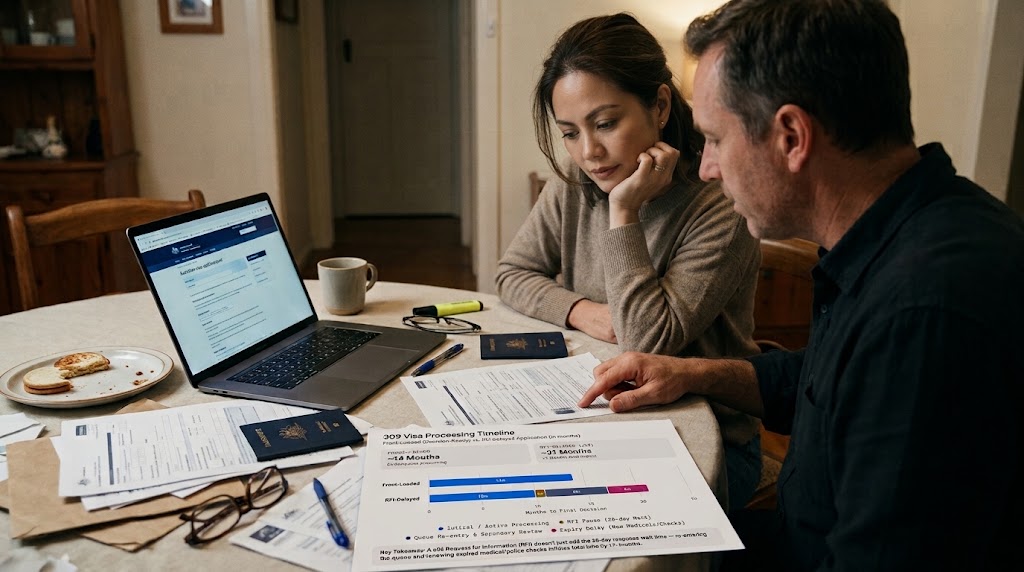
Submitting an incomplete Subclass 309 Partner Visa application adds at least 7 months of unnecessary delays to your total processing time. Missing documents trigger a formal Request for Information (s56), which pauses your application for 28 days, pushes your file to the back of the case officer's review queue, and risks compounding delays if your medical or police checks expire while you wait. To achieve the fastest possible processing timeline—approximately 14 months—your application must be 100% "decision-ready" and fully front-loaded on the exact day you lodge it.
If you are applying for an Australian Subclass 309 Partner Visa, you are likely already bracing yourself for a long wait. The separation from your spouse or partner is arguably the hardest part of the entire migration journey. Naturally, most applicants are desperate to find a way to speed up the processing time and get their loved one to Australia as quickly as possible.
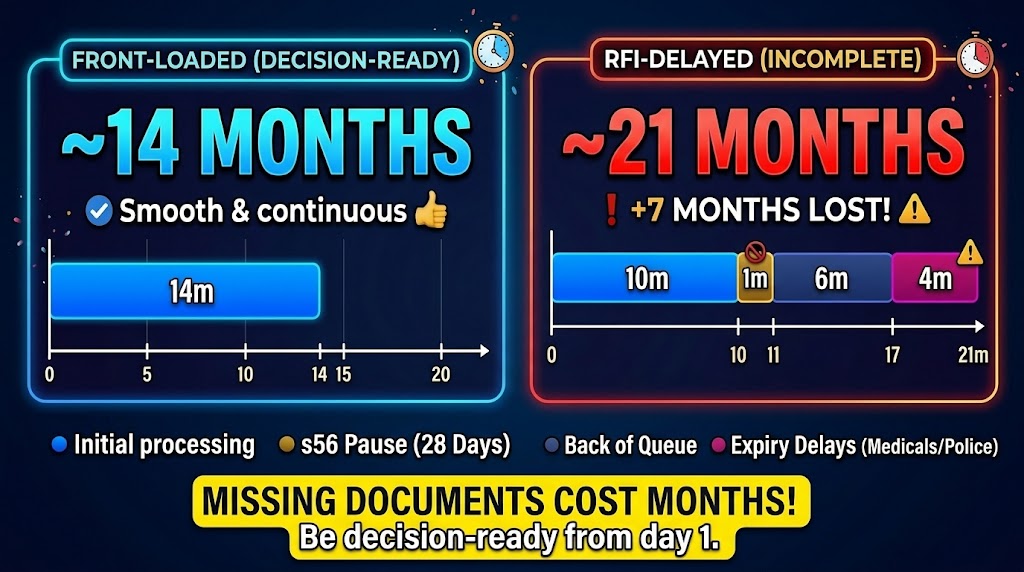
We share a timeline graphic illustrating a stark reality in the world of Australian migration: a "front-loaded," decision-ready application is processed significantly faster than an incomplete, "bare-bones" application. In fact, our graphic shows a potential 7-month difference (or more) between a smooth process and one plagued by delays.
But why exactly does this happen? To understand why missing a few documents on day one can cost you over half a year of waiting, you have to understand exactly how the Department of Home Affairs assesses your file, what happens when they hit a roadblock, and why the DIY strategy of "lodge now, upload later" is a recipe for disaster.
The Myth of "Get in the Queue Now, Upload Later"
A very common, yet dangerously flawed, strategy among unrepresented applicants is the rush to lodge. Many couples believe that the most important thing is to simply pay the Visa Application Charge, hit submit on a basic application with minimal evidence, and "secure their place in the queue." They assume they will have plenty of time over the next 12 to 15 months to slowly gather their relationship evidence and organize their police clearances.
This approach fundamentally misunderstands how visa processing works. The Department of Home Affairs does not operate a simple chronological queue where case officers patiently hold your file open while you slowly trickle in your documents.
Instead, the Department prioritizes efficiency. They operate under a mandate to finalize visas. When a delegate (a case officer) opens your file for the first time, they are looking for one thing: a complete, comprehensive, undeniable picture of a genuine and continuing relationship. If that picture is clear and complete, they can make a decision. If it is not, a bureaucratic machine is triggered—one that immediately puts the brakes on your future.
Think about it!The Case Officer could, in reality, pick up your application, tick all the boxes, and go "OK! Granted!" Now, why wouldn't you want that?
Dissecting the RFI-Delayed Timeline: The 21-Month Trap
Let’s look at the bottom half of our processing timeline graphic: the RFI-Delayed application. This path is exactly what happens when you submit an incomplete application.
1. Initial Processing (The First 10 Months)
Your file sits in the global processing pool (or as we call it, "the big, dusty pile!) until it is assigned to a case officer. After roughly 10 months, a delegate opens your file to begin their assessment.
2. The Assessment Pause and the s56 Request
The case officer discovers that you are missing critical information. Perhaps your relationship statements are vague, you haven't provided sufficient financial evidence, or your police clearances are absent. The case officer cannot legally approve the visa on a hunch. They must stop processing your file immediately and issue a formal Request for Further Information under Section 56 of the Migration Act 1958—commonly known as an s56 or RFI.
3. The 28-Day Statutory Pause
When an s56 is issued, the Department typically grants you 28 days to source, translate, and upload the missing evidence. For those 28 days, your application is effectively frozen. The clock has stopped. This is the first tangible delay, but it is actually the shortest part of the problem.
And note! If you request an extension, IF they grant this, it's further delay!
4. The "Back of the Queue" Reality (The 6-Month Black Hole)
This is the delay that catches most couples completely off guard. Once you finally upload your missing documents on day 27, your case officer does not instantly receive a notification and immediately resume working on your file.
Case officers manage heavy caseloads. When they paused your application to wait for your documents, they moved on to assess dozens of other front-loaded, decision-ready applications. When your documents are finally submitted, your file goes into a secondary review holding pattern. You must now wait until that specific case officer has the administrative capacity to pick your file back up and re-familiarize themselves with your case. As our graphic shows, this queue re-entry can easily add an unnecessary six months of dead time to your wait.
The Cascading Expiry Nightmare
If an s56 request and queue re-entry weren't bad enough, incomplete applications often fall victim to a secondary, cascading delay: the expiry of time-sensitive documents.
Australian immigration law is very strict regarding health and character requirements. Medical examinations (processed through eMedical) and police clearance certificates are generally only valid for 12 months from the date they are issued.
Imagine this scenario: You lodged your bare-bones application and completed your medicals in month 1. Because your application lacked sufficient relationship evidence, it triggers an s56 request in month 10. You spend a month gathering evidence, and then wait six months for the case officer to look at your file again. You are now at month 17.
When the case officer finally re-opens your file, your relationship evidence is now perfect, but your medicals and police checks expired five months ago. The delegate is legally barred from granting the visa. They must issue a second s56 request, asking you to redo your health checks and police clearances. You must book new appointments, pay new fees, wait for the results, and go to the back of the secondary queue all over again.
This is the pink section on our graphic. This cascading expiry loop can easily inflate a standard 14-month wait into a grueling 21-month or even 24-month ordeal, keeping families separated for far longer than necessary.
The Front-Loaded Advantage: Why Decision-Ready Wins
Now, look at the top half of the graphic: The Front-Loaded (Decision-Ready) timeline.
A front-loaded application is one where every single piece of required evidence, i.e., comprehensive relationship statements, joint financial records, social proof, valid police clearances, and timely health checks, is provided on the day the application is lodged.
When a case officer opens a decision-ready file, their job is easy. They review the evidence, verify that the legal criteria are met, assess the health and character clearances, and grant the visa. There is no assessment pause. There is no s56 Request for Further Information. There is no 28-day wait, no losing your spot in the queue, and no risk of your medicals expiring while you wait for a secondary review.
The processing is a smooth, continuous line from lodgement to decision. This single-touch processing is exactly why complete applications move through the system so much faster.
The Dangers of DIY and Fake "Efficiency"
At Down Under Visa, Mila and I see the devastating effects of the DIY approach constantly. Couples come to us for our DIY-Visa Repair Shop services after their self-managed applications have stalled, hit a wall with an s56, or received a Section 57 Natural Justice letter threatening refusal.
In a desperate attempt to create a "complete" application quickly, some applicants have even begun turning to artificial intelligence (AI), like ChatGPT, to write their relationship statements. I cannot warn against this strongly enough. Case officers are trained to look for the genuine, authentic narrative of a human relationship. AI generates sanitized, generic, and often hallucinated details that strip all the truth and emotion out of your story. Providing an AI-generated statement is not "front-loading" your application; it is handing the Department a massive red flag that will trigger severe scrutiny, RFIs, and high refusal risks.
Do It Right the First Time
Operating a full-time migration practice here in the Philippines since 2010, we have managed countless partner visa applications. We know exactly what the Department needs to see to make a swift, positive decision.
Your relationship is not generic, and your visa application shouldn't be either. The goal should never be to just "get in the queue." The goal must be to hand the Department a comprehensive, undeniable, decision-ready file from day one. By front-loading your application with the correct, legally sound evidence, you avoid the s56 trap, bypass the secondary queues, and ensure that your partner can finally come home to Australia as quickly as the system allows.
Jeff Harvie is a Registered Migration Agent (MARN 0959797) and the principal of Down Under Visa, specializing in Australian partner, prospective marriage, and family visas.